
Mantras, Mandalas, and Mindfulness - The Tibetan Path to Awakening
Beyond the Buzzwords: Unpacking Mantras, Mandalas, and Mindfulness on the Tibetan Path to Awakening
You've likely encountered "mindfulness" apps promising serenity, perhaps idly colored a mandala, or passively listened to an "Om" chant. But what if these aren't just trendy wellness tools, but ancient, sophisticated technologies – a kind of applied science of consciousness – designed to fundamentally transform our experience of reality? Tibetan Buddhism, particularly its "resultant vehicle," offers a profound perspective: to actively use enlightened qualities, to rehearse them, as a means of awakening our own inherent potential. And at the heart of this approach lies a potent synergy: Mantras, Mandalas, and Mindfulness, a transformative triad working on the levels of body, speech, and mind.
The "How-To" of Awakening: What Are These Mystical Tools Anyway?
So, how does one actually do this awakening? Let's unpack these seemingly mystical tools.
- Mantras: The Mind's Sonic Shield. More than mere humming, a mantra is a sacred sound or phrase, a sonic representation, a "protection of the mind" as the name implies. Think of them as energetic formulas. The iconic "Om Mani Padme Hum," for instance, isn’t just a pretty tune; it's considered a tuning fork for compassion, aligning our inner "radio" to receive and broadcast that enlightened frequency. Mantras are power words, carrying within them the vibrations of awakened awareness.
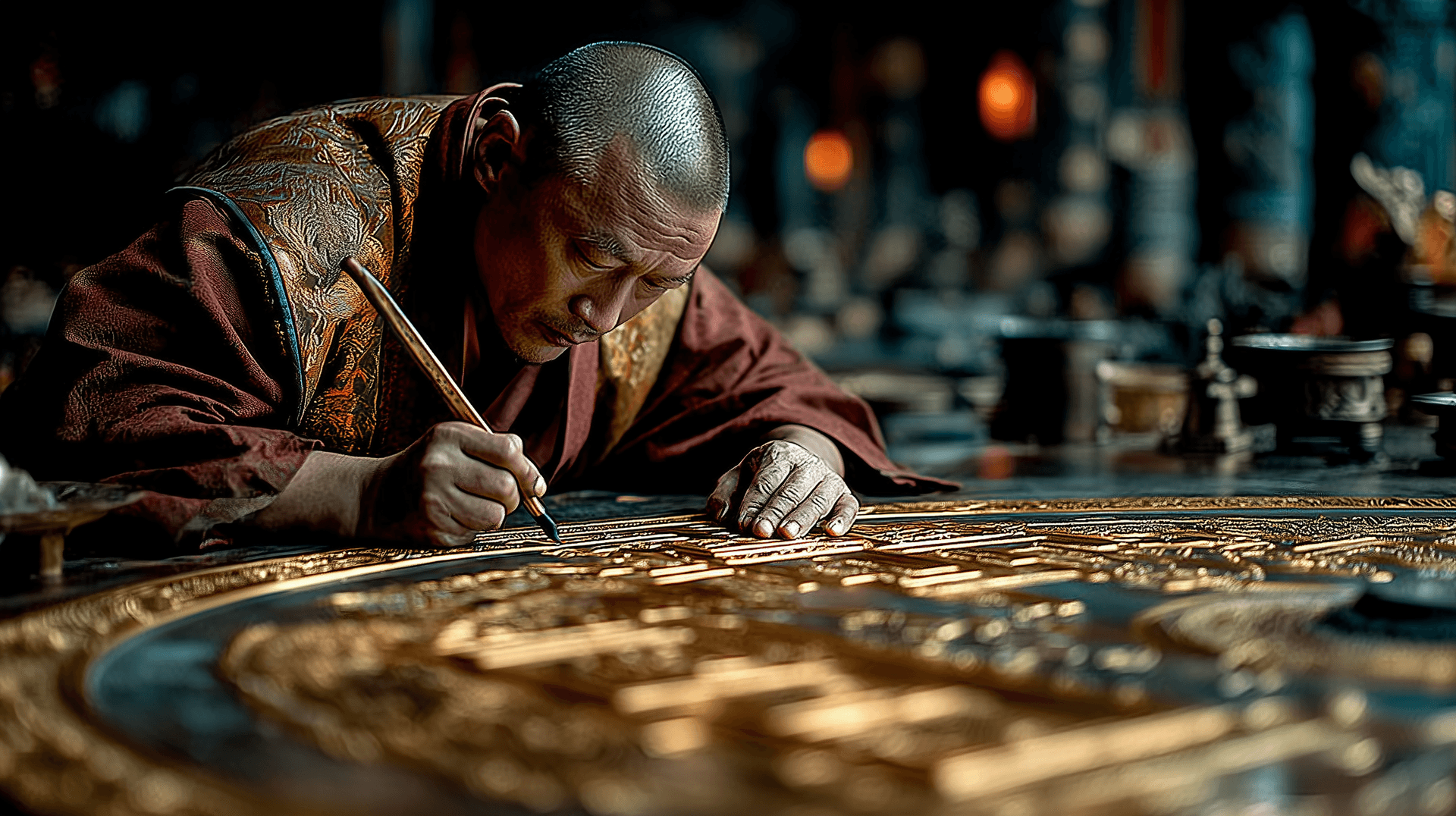
- Mandalas: The Universe's Blueprint. Far from a simple, albeit intricate, pattern, a mandala is a complex geometric representation of a "celestial palace." Imagine it as a visual roadmap, a symbolic journey from the chaos of our ordinary perception to the pristine clarity of enlightened awareness. It is, in essence, an architectural diagram of a pure mind. Each line, color, and deity meticulously placed to guide the practitioner toward inner harmony and realization.
- Mindfulness (*Drenpa*): The Glue that Holds it All. Often translated as "mindfulness," the Tibetan term drenpa carries a weight of meaning closer to "remembrance" or "steady presence." It's the vital ingredient, the catalytic agent in this alchemical process. Without it, mantras devolve into mere noise, mandalas into pretty, but ultimately meaningless, doodles. Drenpa provides the focus, the sustained attention, that allows the magic to truly happen.
- The Power Trio: Body, Speech, Mind United (Deity Yoga). The Tibetan tradition speaks of the "Three Vajras" – the indivisible unity of body, speech, and mind. Mandalas primarily work with the mind, mantras with speech, and mindfulness serves as the crucial integrator, connecting them all. Consider the practice of Deity Yoga. Here, mindfulness prepares the ground, allowing us to vividly visualize ourselves as an enlightened being within the mandala. Then, the mantra vibrates that reality into being, weaving it into the fabric of our experience. It is a "soul laboratory" where we actively rehearse enlightenment, pre-experiencing and embodying the qualities we aspire to manifest.
A Glimpse into the Past: Where Did This Cosmic Trio Come From?
The roots of this powerful triad lie in the rich soil of ancient Indian Tantra, blossoming between the 6th and 12th centuries. Initially, mantras served as potent spells, invocations, while mandalas began as relatively simple diagrams used in ritual practices. These practices were carried over the Himalayas, with two major waves of transmission into Tibet. Visionaries and practitioners transformed these seeds into the sophisticated system we see today. 3D mandalas, like the design of Samye Monastery, were deliberately constructed as physical representations of the Buddhist cosmos. Consider also the legacy of the 84 Mahasiddhas, unconventional Indian yogis whose radical approach to practice laid much of the groundwork for these profound techniques.
The lineage legacy within Tibetan Buddhism is also varied and nuanced. Each school – Nyingma, Kagyu, Sakya, Gelug – brings its unique flavor to the practice of mantras and mandalas. Consider the Nyingma school's focus on the Vajra Guru mantra, the Kagyu's emphasis on Chakrasamvara, the Sakya's on Hevajra, and the Gelug's on Kalachakra. Similarly, mandala styles vary from wrathful protector forms to incredibly detailed internal visualizations, or even the intricate Ngor style. The Kalachakra sand mandala, with its painstaking creation and subsequent dissolution, stands as an iconic representation of beauty and the inherent impermanence of all things.
Tibetan Buddhism Today: A Tale of Two Worlds (and a Digital Revolution)
Today, Tibetan Buddhism finds itself navigating a complex landscape, both in the East and the West.
- East: Resilience Amidst Pressure (2024-2025). Within Tibet itself, we see a story of "clandestine devotion" existing alongside increasing state control. The ongoing "Sinicization" policies imposed by China, the demand for forced allegiance, and the omnipresent surveillance create a challenging environment. The stories of protests, such as those surrounding the Kamtok dam, are a testament to the enduring spirit of the Tibetan people. In Bhutan and Mongolia, we observe a thriving spiritual culture, but one that must carefully navigate the currents of modernization and geopolitical realities. India remains a crucial lifeline, serving as a refuge for the exiled community. Dharamshala continues to be a vibrant hub, and the ongoing discussions surrounding the Dalai Lama's succession are of critical importance. The recent "Resolve Tibet Act" represents a significant diplomatic boost, reaffirming international support for the Tibetan cause.
- West: Mind Science Meets Spiritual Seeking. In the West, we see the rise of "Western Lamas," teachers who skillfully blend ancient wisdom with contemporary Western psychology and neurobiology. However, this also gives rise to the "Mindfulness Inc." debate. Has "contemplative science," embraced by companies like Google and Apple as a tool for stress relief, lost its spiritual depth? Are we at risk of diluting a profound tradition into a mere shadow of its former self? It also means moving beyond romanticized notions of "Shangri-La" and embracing a more realistic understanding of the complex history and human challenges within the tradition.
- The Digital Sangha: Enlightenment in the Cloud. The digital revolution is profoundly impacting the transmission and practice of Tibetan Buddhism. AI tools like Monlam AI and initiatives like 84000 are democratizing access to esoteric texts, making them available to a global audience. "Digital monasteries" and online retreats are connecting practitioners across geographical divides, creating virtual communities that transcend physical limitations.
The Elephant in the Room: Controversies and Sticky Situations
It's impossible to discuss Tibetan Buddhism today without acknowledging some uncomfortable truths.
- "Me Too" in the Monastery: The scandals that have rocked prominent organizations like Rigpa and Shambhala serve as a stark reminder that no institution is immune to human failings. These events have challenged the idealized image of spiritual leaders and sparked a demand for ethical accountability, rejecting the harmful rationalizations often cloaked in the guise of "crazy wisdom."
- Cultural Appropriation vs. Appreciation: Where Do We Draw the Line? The line between honoring and appropriating sacred traditions is often blurry. Is it acceptable to see Buddha images adorning Keds, or Tibetan script emblazoned on jeans? Are we reducing profound spiritual technology to mere "cool aesthetics"? There's a legitimate fear that commercialized versions will ultimately erase the original meanings and rituals. Yet, we also must acknowledge the paradox of refugee artists who rely on selling sacred art for their survival. And what about tattoos – are they sacred vows etched on the skin, or simply pretty pictures devoid of deeper meaning?
- Spiritual Bypassing: The Shortcut Dilemma: In our tech-saturated world, the allure of instant gratification is strong. But can we truly attain the feeling of enlightenment through technology without undergoing the necessary ethical and philosophical training? Are we simply bypassing the hard work of self-reflection and ethical development?
The Future is Now (and Beyond): Brain Hacks, AI, and Global Well-being
The convergence of ancient wisdom and cutting-edge science is opening up fascinating possibilities.
- Mind-Bending Neuroscience: The "Awakened Brain." We're moving beyond basic mindfulness, now targeting "advanced states" like non-dual awareness with technologies like transcranial focused ultrasound (tFUS), potentially offering "equanimity on demand!" Neuroscientists are mapping "brain criticality," exploring how expert meditators balance order and chaos to achieve states of lucid awareness. Tibetan monastics are actively participating in research, leading studies on Dream Yoga in sleep labs, pushing the boundaries of our understanding of consciousness. The predictive coding model suggests that meditation might "hack" our brain's predictive models, leading to a more direct and unfiltered experience of reality.
- Mindfulness for the Masses: Global Health & Healing. The application of mindfulness is expanding beyond stress reduction. Clinical models are embracing analytical compassion (CBCT) and the practice of Tonglen as tools to combat burnout and promote well-being. Initiatives like SEE Learning are bringing Tibetan ethics and compassion into K-12 schools worldwide. Even Sowa Rigpa (Tibetan Medicine) is gaining mainstream recognition, with integration into public health systems, AI analyzing ancient formulas, and the exploration of "meditation as a prebiotic" for gut health!
- Ethical Frontiers: Power and Purpose. As we harness the power of these technologies, ethical considerations become paramount. Could meditative clarity be "weaponized" through brain-computer interfaces? We must constantly grapple with the question of technology's role: is it an enhancer or a diluter of genuine spiritual transformation?
Conclusion: A Timeless Path in a Changing World
Mantras, Mandalas, and Mindfulness are far more than simple techniques; they represent a dynamic, evolving system for profound transformation. This tradition faces intense external pressures and internal evolution, constantly adapting while striving to preserve its core wisdom. Whether you're seeking inner peace, mental clarity, or a deeper understanding of consciousness, the Tibetan path continues to offer a rich, complex, and surprisingly cutting-edge journey to awakening. It's a journey that demands not only practice but also critical reflection, ethical engagement, and a willingness to embrace both the challenges and the immense potential that lies within.