
The "Brake Pedal" for Your Brain: How Sound Silences Stress
The "Brake Pedal" for Your Brain: How Sound Silences Stress
We exist in a state of perpetual acoustic assault. The modern world is a cacophony of notifications, transit hums, and the relentless internal monologue of "what’s next." In this environment, our nervous systems are often stuck in a high-alert feedback loop, a chronic activation of the sympathetic nervous system. But what if we viewed sound not as another layer of noise, but as a precision tool—a biological remote control capable of toggling the body back into its "rest and digest" state?
1. The Body’s Secret "Off" Switch
When we experience a moment of profound calm while listening to a cello suite or the rhythmic wash of the tide, we aren't just "feeling good." We are witnessing the activation of the Parasympathetic Nervous System (PNS). If the sympathetic system is our accelerator—priming us for fight or flight—the PNS is the brake pedal. Science is increasingly revealing that specific auditory stimuli can bypass our conscious anxieties and speak directly to the brainstem, triggering a physiological shift that "vibes" alone cannot explain.
2. The Mechanics of Chill: How Your Body "Listens"
The relationship between sound and biology is deeply somatic. Consider the phenomenon of Entrainment. This is the tendency for two oscillating bodies to lock into a shared rhythm. When we listen to music in the 60–80 BPM range, our heart rate and even our respiratory patterns naturally slow down to synchronize with the tempo. It is a literal, mechanical calibration of the human engine.
Beyond rhythm, we must look at the Vagus Nerve. As the longest cranial nerve in the body, it serves as the command center for relaxation, snaking from the brain through the throat and down to the digestive tract. Sound—particularly low-frequency vibrations or even our own vocalizations—physically stimulates this nerve. This "Vagus Nerve Hack" signals to the brain that we are in a safe harbor, initiating a "chemical warfare" on stress. The result? A precipitous drop in cortisol and a flood of dopamine and endorphins, the brain’s own restorative elixirs.
3. A Quick Trip in the Wayback Machine
The concept of sound as medicine is anything but a modern invention; we are merely rediscovering what our ancestors intuited through ritual. Pythagoras, the father of geometry, was equally obsessed with the "music of the spheres," utilizing the lyre to treat "unwelcome passions" and emotional volatility. Across the Mediterranean, Ancient Egyptians designed "acoustic sanatoriums" where the resonant properties of architecture were used to facilitate healing. Even further back, the 40,000-year-old didgeridoo served as a primitive ultrasound, using deep, vibrating drones to address physical and spiritual ailments.
The transition into the clinical realm occurred after World War II. When musicians began playing for veterans suffering from what was then called "shell shock," the physiological benefits were so undeniable that music therapy was formalized as a legitimate medical discipline.
4. Current Expert Consensus: The Serenity "Dose"
In the realm of sound therapy, the "dose" is as critical as the medium. Research suggests a 10-Minute Rule: the human nervous system requires roughly 10 to 20 minutes of consistent auditory exposure before the biological markers of relaxation—such as lowered blood pressure and reduced heart rate variability—fully manifest.
However, the "prescription" is deeply personal. While a generic "Zen Garden" playlist might provide a baseline, experts emphasize that a track for which you have a personal affinity often yields superior results. Your "guilty pleasure" may be more efficacious than a tibetan bowl if it triggers a stronger positive emotional response. That said, nature remains the gold standard. Birdsong and the patter of rain are "atavistic" sounds; they signal to our primal brain that the environment is stable and predators are absent.
5. The Spicy Stuff: Science vs. Snake Oil
As sound therapy gains mainstream traction, it is essential to distinguish between neurological fact and marketing fiction. Take the Binaural Beat debate. The idea that playing two slightly different frequencies in each ear can "entrain" the brain to specific wave states (Alpha, Theta, Delta) is compelling, but the clinical evidence remains a patchwork of promising trials and placebo-heavy results.
More problematic are the specific "healing frequencies" often touted on social media. Claims that 528 Hz can "repair your DNA" or that 741 Hz "removes toxins" are, to put it bluntly, pseudoscience. While these frequencies may sound pleasant or "warm," there is no molecular biological evidence to support DNA alteration through sound waves. Similarly, the 432 Hz War—the claim that tuning music slightly lower than the standard 440 Hz is "universally healing"—is largely a matter of aesthetic preference rather than a mathematical law of nature.
6. The Sci-Fi Future of Serenity
We are entering an era of "Cyber-Zen." New AI-driven platforms like Endel generate generative soundtracks in real-time, pulling data from your heart rate, the weather, and even the time of day to create a bespoke "sound cocoon."
Perhaps most exciting is the research into 40 Hz Gamma sounds. Emerging studies suggest that exposure to these specific auditory (and sometimes visual) pulses may stimulate the brain’s microglia—cells that act as a "cleanup crew"—to remove the plaques associated with Alzheimer’s disease. We are also seeing the rise of "haptic" technology, such as vibrating vests and headbands, that allow the user to feel the music, providing a visceral, tactile grounding that can pull someone out of a panic attack in seconds.
7. Conclusion: Just Hit Play
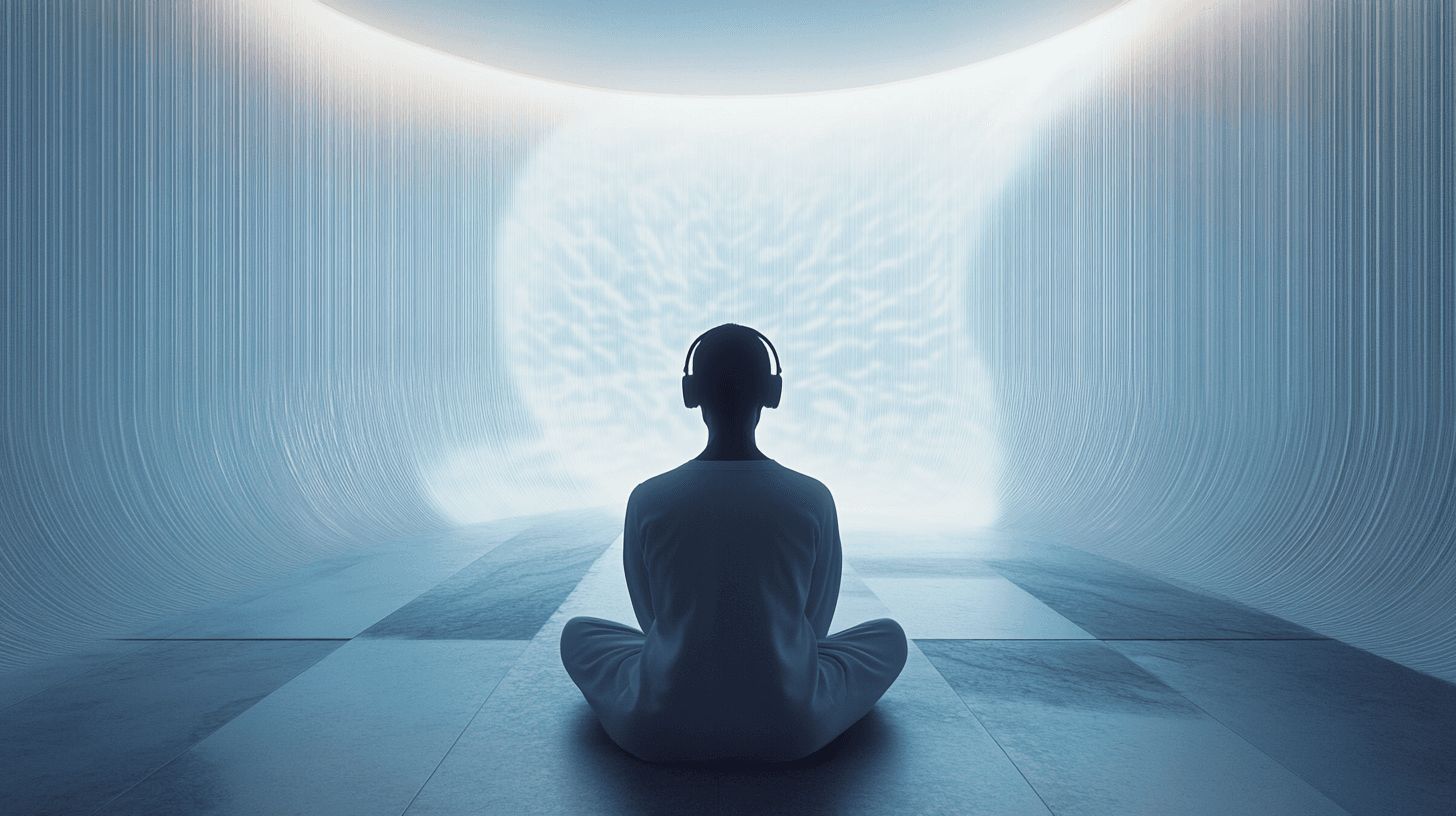
The intellectual examination of sound therapy leads us to a simple, inescapable conclusion: serenity is not a passive state we wait for; it is a skill we can cultivate through our environment. The biology of the human body is designed to respond to the harmony of the world around it. We don't need a sprawling laboratory or a medical degree to reclaim our peace. Sometimes, the most profound act of self-care is simply putting on a pair of headphones, closing our eyes, and letting the frequency of the world drift away for fifteen minutes.
The brake pedal is right there. You only need to hit play.