
The Whirling Dervishes - More Than Just a Dance
The Whirling Dervishes: More Than Just a Dance
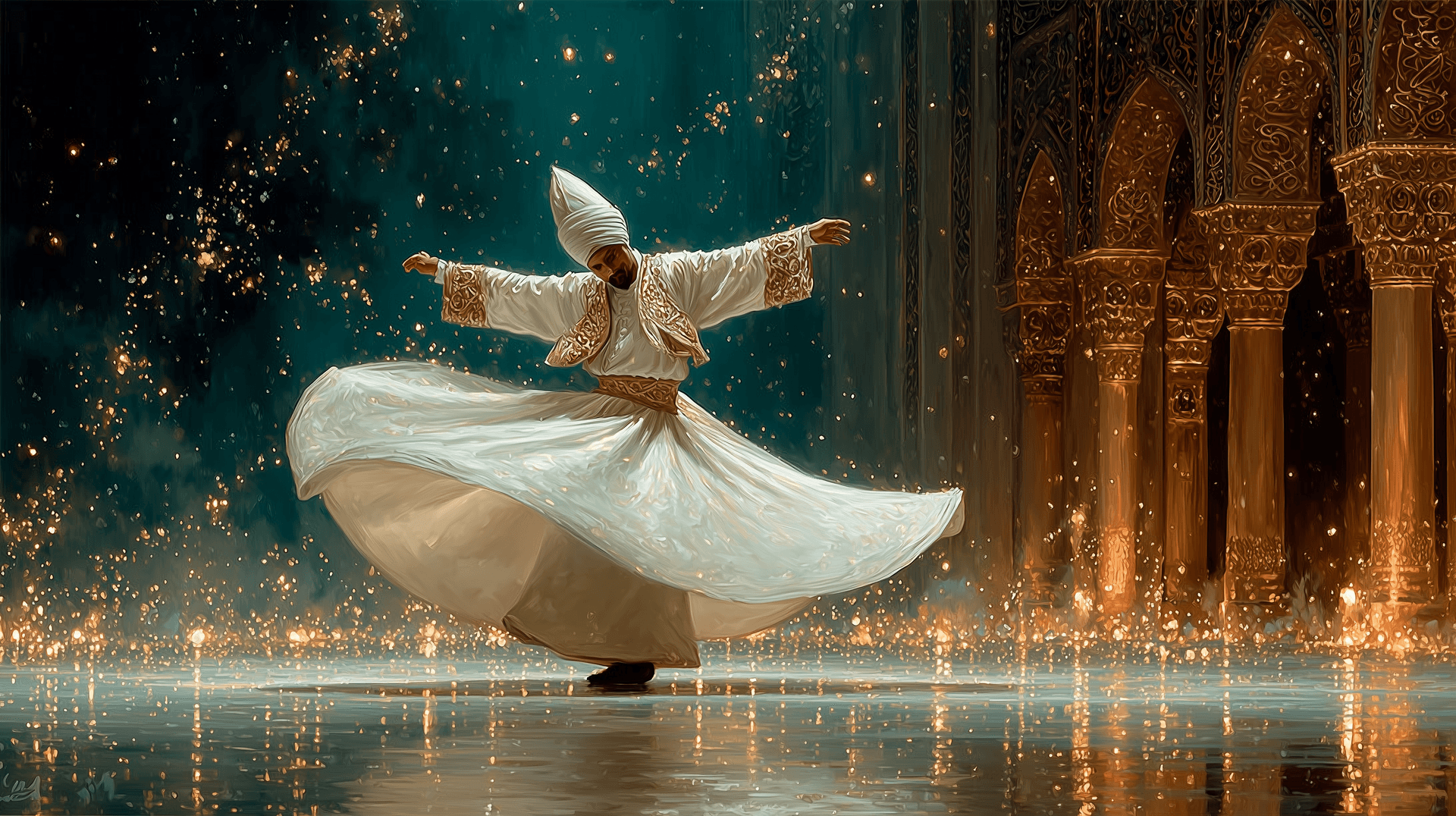
Ever been captivated by the mesmerizing dance of the Whirling Dervishes? What appears to be a performance is, in fact, a profound spiritual journey known as Sama, central to the Mevlevi Order of Sufism. But how can such intense spinning lead to such apparent deep peace? Is it an illusion or a genuine path to divine connection? The answer, like the whirling itself, is more complex than it first appears. “Stillness in motion” seems paradoxical, yet within this seeming contradiction lies the heart of the Sufi experience.
1. The Rumi Origin Story: A Poet's Ecstasy
To understand the Dervishes, we must journey back to 13th-century Konya and imagine the scene: the great poet Jalaluddin Rumi, consumed by grief over the loss of his spiritual mentor, Shams Tabrizi. Legend has it that Rumi, hearing the rhythmic hammering of goldbeaters, was transported into a state of ecstatic remembrance, dhikr, and began to whirl spontaneously. This wasn't mere movement; it was a physical manifestation of his longing for the Divine. His son, Sultan Walad, recognizing the transformative power of this experience, codified this raw ecstasy into the structured Sama ceremony we recognize today, preserving his father's inspired movements for generations to come.
2. Deciphering the Whirling: It's Not a "Dance," It's a Prayer
Sama is not merely a dance; it's a prayer, a meditation, a spiritual ascent. The very word "Sama" means "listening" – listening to the music, the poetry, and, most importantly, to the voice of the Divine within. The ceremony is structured around the Four Salams, each representing a distinct stage of the spiritual journey. The first acknowledges our existence; the second, the rapture of divine love; the third, the annihilation of the self, fana; and the fourth, the return to the world, transformed and ready for service. But perhaps the most compelling aspect of the whirling is the paradox of stillness. While the body spins, the Dervishes cultivate an unmoving center within, a point of focused presence that transcends the dizzying motion. It's not about losing control but about finding a deeper connection to the divine. This state is often described as "sober intoxication." The trance isn't unconsciousness but rather a wajd, a heightened awareness, a direct union with the Divine while remaining grounded in the present moment.
3. The Dervish Dress Code: Every Thread a Symbol
The iconic attire of the Whirling Dervishes is not merely ceremonial; it's a language of symbols, each element rich with meaning. The Sikke, the tall, conical hat, represents the tombstone of the ego, a constant reminder of the need to transcend self-centeredness. The Tennure, the flowing white robe, symbolizes the ego's shroud and the purity of the soul. The Hirka, the black cloak worn at the beginning of the ceremony, represents the material world, which is shed to reveal the spiritual rebirth beneath. Even the positioning of the arms holds significance: one hand is raised, receiving grace from above, while the other is lowered, bestowing that grace upon the earth. This symbolizes the interconnectedness of all things and the Dervish's role as a conduit for divine blessing. The crossed arms further symbolize the "Oneness of God", a core concept in Sufi philosophy.
4. Beyond the Whirling: Other Sufi Paths to the Divine
While the Whirling Dervishes are perhaps the most visible expression of Sufism, they represent just one path among many. At the heart of all Sufi traditions lies Dhikr, the remembrance of God, practiced both vocally (Dhikr-i Jahr) and silently (Dhikr-i Khafi). Muraqaba, contemplation, involves the practice of watching the heart, seeking to perceive the subtle signs of the Divine within. Other orders engage in Hadra, communal rhythmic swaying that evokes a shared sense of divine presence. Some paths are even more physically demanding, such as the "sawing" Dhikr, a practice designed to cut through the layers of the ego with intense physical exertion.
5. Modern Twists & Turns: Sufism in the 21st Century
Sufism, far from being a relic of the past, continues to evolve and adapt to the modern world. "Urban Sufism" sees practitioners integrating their spiritual lives with demanding careers and the complexities of city life. The Sufi emphasis on Khalifa, stewardship, has led to movements promoting ecological responsibility and environmentalism. Sufi principles of peace, justice, and compassion also contribute to peace-building efforts worldwide, often recognized by institutions like the UN on occasions such as the International Day of Living Together in Peace. Perhaps most intriguingly, the digital age has given rise to "Digital Dhikr," virtual communities, and even online shaykhs. While the role of AI in Sufi thought is still being debated, the potential for technology to facilitate spiritual connection is undeniable.
6. The Whirlwind of Controversy: Sacred vs. Spectacle
The path of the Whirling Dervishes is not without its controversies. Some traditionalists within Islam view Sama as a sinful innovation, bid'ah, questioning its validity as a form of worship. This contrasts with the views of Sufi scholars, like Imam Ghazali, who have defended its spiritual merits. The transformation of Sama into a tourist attraction, particularly in Turkey and Egypt (where it is sometimes conflated with the Tanoura dance), raises concerns about commercialization and the loss of spiritual rigor. The "Rumi Phenomenon" and the appropriation of Sufi whirling by Western New Age movements often strip it of its Islamic context, contributing to a "spiritual but not religious" interpretation that overlooks the tradition's rich historical and theological foundations.
7. Looking Ahead: The Future Spin of Sufism
Looking ahead, Sufism faces both opportunities and challenges. Globalization has facilitated the spread of Sufi teachings, with English emerging as a common language for international communities. State-sponsored initiatives sometimes promote a "moderate" version of Sufism. Digitalization continues to transform the landscape, with virtual rituals, online mentors, and ongoing debates about the nature of spiritual transmission in the digital realm. In an increasingly secular world, Sufism offers a compelling path to mental well-being, finding application in psychotherapy, and providing a "rational, aesthetic" form of spirituality for those seeking meaning beyond traditional religious frameworks. However, challenges remain, including critiques from New Age perspectives, opposition from anti-Sufi movements, and the decline of traditional master-disciple relationships.
Conclusion: The Enduring Dance of the Soul
The Sufi whirling is far more than just a performance; it’s a profound spiritual discipline with a rich history, deep symbolism, and an evolving presence in the modern world. It's a testament to the enduring human quest for divine love and the possibility of finding stillness amidst life's relentless motion, reminding us that even in the most turbulent of times, the soul can find its center and dance its way home.